Incident location, Long Island
What Happened
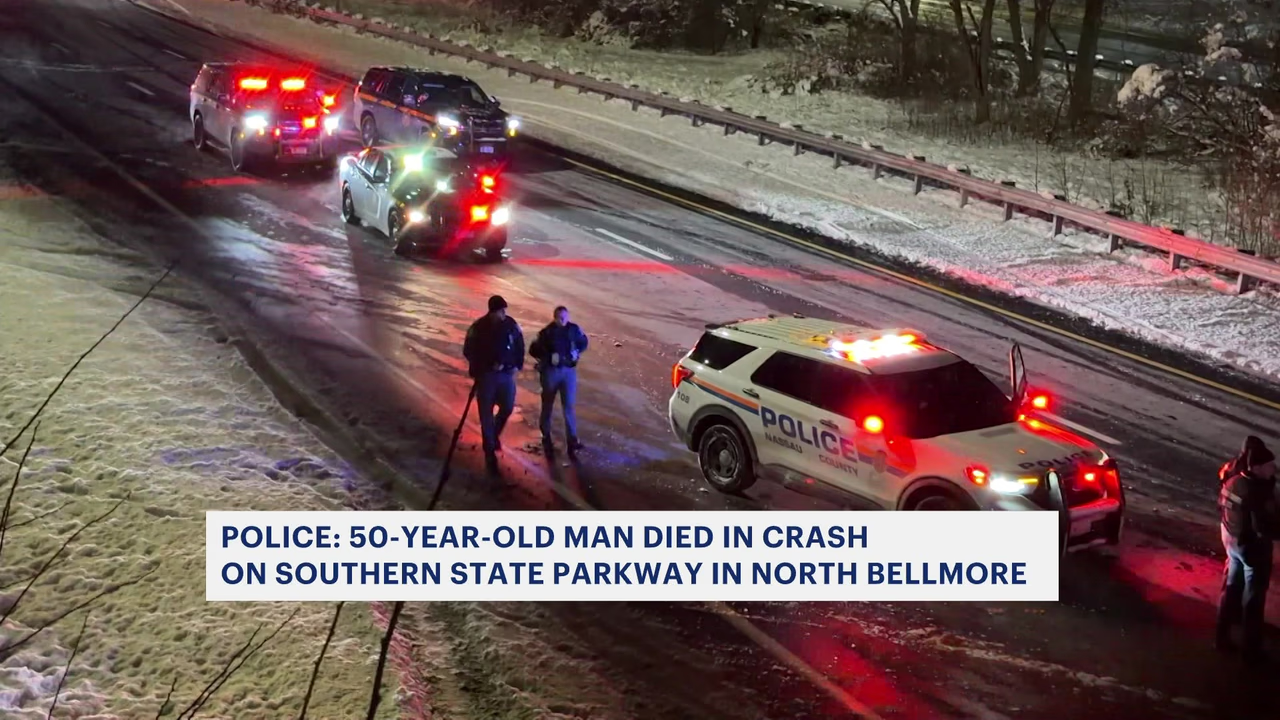
A 50-year-old man is dead after a late-night crash on the Southern State Parkway in North Bellmore on Sunday, December 14, 2025, in a tragedy that state police say was driven by speed.
According to News 12, state police identified the victim as Charles Kenney, 50. The crash occurred around 10:30 p.m. near Exit 25S on the Southern State Parkway. Kenney was transported to Nassau University Medical Center following the collision, where he was later pronounced dead. The incident was published on December 15, 2025, at 12:39 p.m., and subsequently updated by News 12 staff.
As reported by News 12, video footage obtained by the outlet shows Kenney’s truck coming to a complete stop underneath an overpass near the crash site. The nature of the collision — whether the vehicle struck the overpass structure, a guardrail, a median, or simply lost control and came to rest — was not detailed in initial reports. However, the visual evidence of the truck halted beneath the overpass is consistent with a high-speed, single-vehicle incident in which the driver lost control before coming to rest in that position.
State police confirmed that speed was a factor in the fatal crash. No other vehicles appear to have been involved based on the information available, and no passengers or bystanders were reported injured. Kenney was the sole victim identified at the scene by authorities.
The crash took place in the late-night hours on a Sunday, a time when traffic volumes on the Southern State Parkway are typically lower but when speed-related incidents are historically more prevalent due to reduced congestion and reduced law enforcement visibility. The darkness of a mid-December night — with sunset occurring well before 5:00 p.m. at that time of year on Long Island — would have further compounded the hazardous conditions of high-speed travel on the parkway.
As of the time of News 12’s report, no charges had been filed, as Kenney himself was the sole operator involved and did not survive the crash. The investigation into the precise mechanics of the collision remained ongoing as of the initial publication of this report.
Location & Road Context
The crash occurred on the Southern State Parkway near Exit 25S, which serves the North Bellmore area of Nassau County. The Southern State Parkway is one of Long Island’s oldest and most heavily traveled limited-access roadways, stretching from the Queens–Nassau border westward to the Heckscher State Park entrance in the east. The stretch near Exit 25S passes through a densely populated section of Nassau County’s South Shore, where the parkway features multiple overpasses, ramps, and tight curves that can become especially unforgiving at high speeds.
Our database records 446 incidents on the Southern State Parkway, making it one of the most crash-prone corridors on Long Island. Recent incidents include a crash on May 25, 2026, a crash on May 24, 2026, and a crash involving property damage at Exit 37S on May 22, 2026, underscoring the parkway’s persistent safety challenges across all seasons.
Broader Impact
Speed-related fatalities on New York’s parkway system remain a persistent and deadly pattern. The Southern State Parkway, originally designed in the Robert Moses era for leisure driving at lower speeds, now accommodates modern commuter traffic at volumes and velocities its infrastructure was never fully engineered to handle. In single-vehicle, high-speed crashes like this one — where no second party is present to slow or redirect the vehicle — there is rarely any margin for error. The loss of Charles Kenney near Exit 25S is a sobering reminder of the irreversible consequences of excessive speed on a roadway that, despite its age, continues to carry thousands of Long Islanders home every night.