
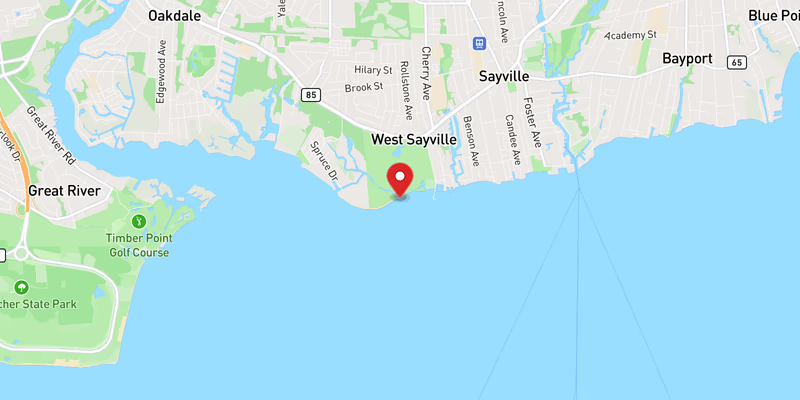
About Montauk Highway
Montauk Highway is the historic spine of Long Island’s south shore — a roughly 95-mile surface route that runs entirely within Suffolk County, from the Amityville–Copiague line in the west to Montauk Point State Park at the far eastern tip of the island. At its western end the road continues into Nassau County as Merrick Road; at its eastern end it dead-ends at the lighthouse. Unlike a single uniform expressway, Montauk Highway is a patchwork of designations and characters: it is the village main street in a dozen south-shore communities, a county road through the eastern Pine Barrens, and a state parkway for its final approach to Montauk. Daily traffic varies enormously by segment and season — busy central-Suffolk stretches can carry well over 30,000 vehicles on a weekday, while the open eastern segments run far lighter in the off-season before summer weekends push the whole corridor to saturation.
History and route designation
Montauk Highway follows the alignment of the colonial-era South Country Road, the stage route that connected the south-shore settlements long before the automobile. The modern route number, NY 27A, was assigned around 1931 as an alternate of NY 27. In 1972, when NY 27 (Sunrise Highway) was extended and realigned to the east, the state truncated NY 27A’s eastern end back to Great River, leaving the central and eastern portions of Montauk Highway to be maintained as county roads. The final stretch into Montauk — the Montauk Point State Parkway — is a Robert Moses–designed parkway, one of the last pieces of his Long Island parkway network, and as a parkway it prohibits commercial trucks.
Route geometry, west to east
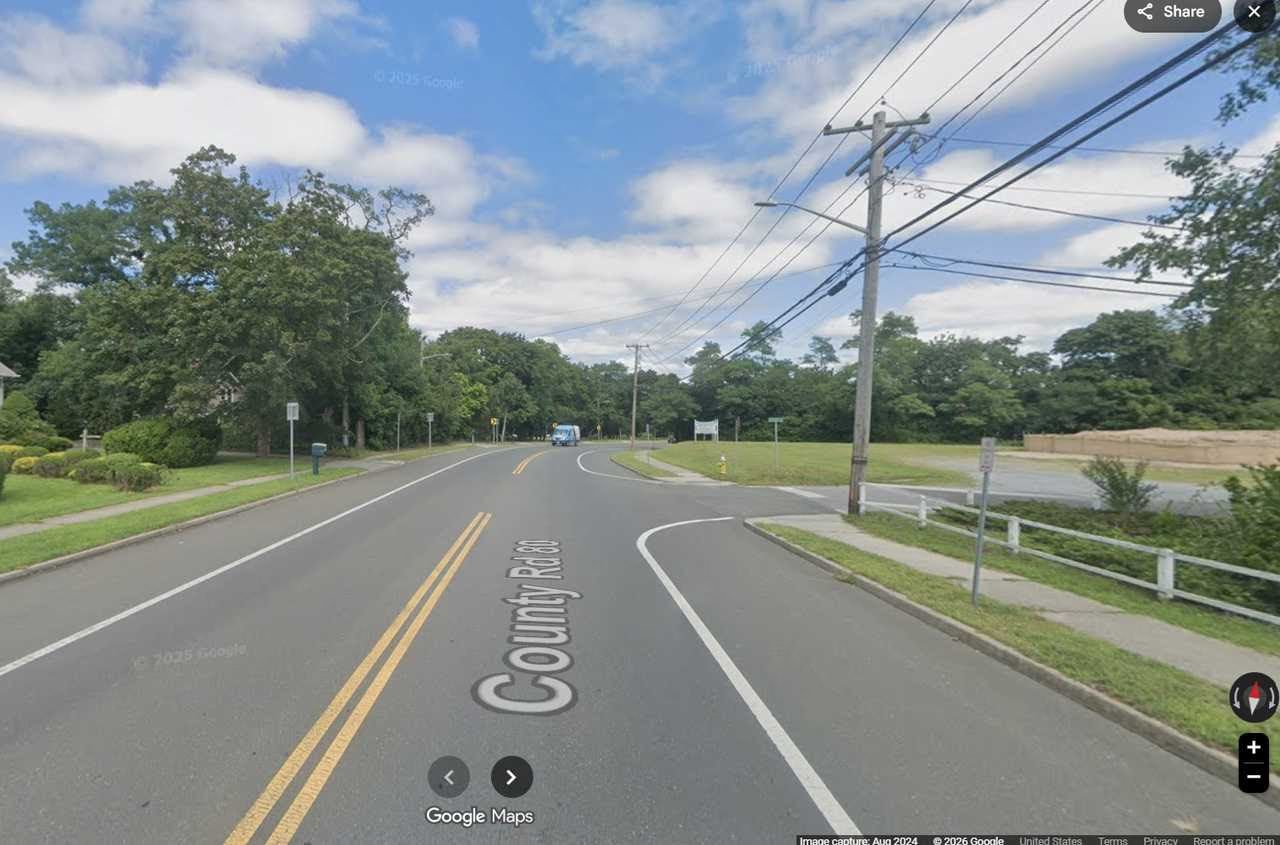
Montauk Highway begins at the Amityville–Copiague line, the Nassau–Suffolk county boundary, carrying NY 27A eastward. It passes through Amityville, then Lindenhurst — where it is signed West Montauk Highway on the village’s western side and East Montauk Highway on its eastern side — before reaching the village of Babylon. From there it continues through West Islip, Bay Shore, the hamlet of Islip, East Islip, and Great River, where the NY 27A designation ends. East of Great River the road becomes county-maintained (CR 85, then CR 80) through Sayville, Patchogue, and the Moriches before reaching the East End. Beyond Southampton it joins NY 27 and runs through the Hamptons villages — Southampton, Bridgehampton, East Hampton, and Amagansett — before becoming the Montauk Point State Parkway across the Napeague isthmus and out to Montauk Point. Throughout Suffolk it is frequently signed simply as Main Street where it forms a community’s commercial core.
Jurisdiction and patrol
Because the corridor crosses several town and village lines, no single agency patrols all of Montauk Highway. The Suffolk County Police Department (SCPD) covers the western and central segments through the towns of Babylon, Islip, and Brookhaven. On the East End, the towns of Southampton and East Hampton maintain their own departments — Southampton Town Police and East Hampton Town Police — with primary jurisdiction, and incorporated villages (Southampton Village, East Hampton Village, Westhampton Beach, Quogue, Sag Harbor) field their own forces within their limits. New York State Police Troop L patrols the NY 27 and Montauk Point State Parkway portions. This jurisdictional mix is one reason crash data on the corridor is reported through multiple feeds rather than a single source.
Speed limits and commercial traffic
Speed limits change constantly along Montauk Highway because the road’s character changes constantly. Through the village main streets — Amityville, Babylon, Bay Shore, Patchogue, Southampton, East Hampton — posted limits are typically 30 mph, dropping further in school and pedestrian zones. On open suburban and semi-rural stretches the limit rises to 40–45 mph, and the limited-access Montauk Point State Parkway segment is posted up to 55 mph. Commercial trucks rely on the surface portions of the corridor for local deliveries and for the seasonal landscaping, construction, and service traffic that swells the East End every summer — the so-called “Trade Parade.” The Montauk Point State Parkway, as a parkway, bans commercial vehicles entirely, funneling truck traffic onto the surface route.
Recent Editorial Coverage
Recent Montauk Highway incident reporting from the Long Island Traffic data desk:
- Two-Car Crash on Montauk Highway in Mastic Sends 3 to Hospital — a late-night intersection collision at Madison Street that required the jaws of life
- Westbound Driver Charged with Drug Impairment in Multi-Vehicle Montauk Highway Crash — a head-on, multi-injury wreck on the East End
- East Hampton Man Charged with DWI After Fleeing Water Mill Crash — a hit-and-run at the Montauk Highway / Proprietors Road intersection
- Three-Car Crash Near Ocean Colony Resort Sends One to Hospital by Helicopter — a serious multi-vehicle crash on the Napeague stretch
- Six Drivers Arrested for DWI in South Fork Weekend Crackdown — a weekend snapshot of impaired-driving enforcement along the East End corridor
For the complete corridor archive, see /accidents/ and filter by road.