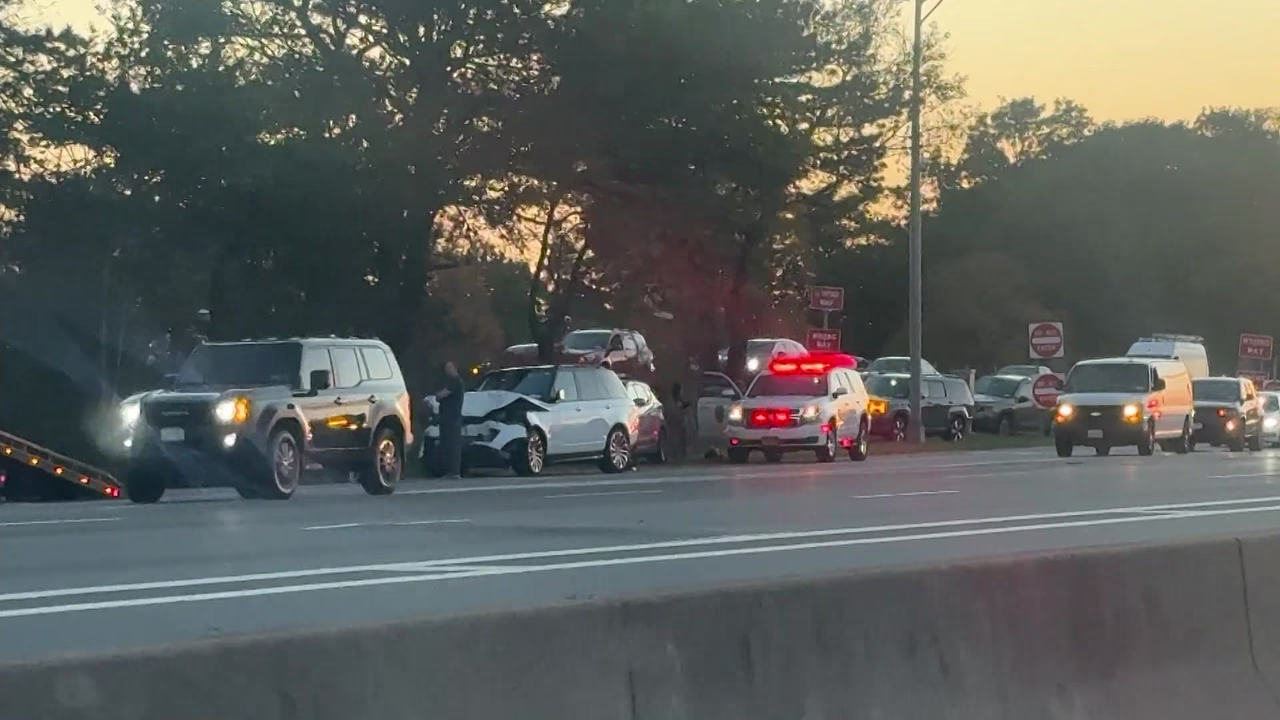
Incident location, Long Island
What Happened
Four Long Island roadways rank among the ten deadliest in all of New York State, according to a new five-year study published by I-Select and reported by News 12 Long Island on January 13, 2026. The study analyzed fatal crash totals across the state’s major roads over a five-year period, and Long Island’s results are stark: the Long Island Expressway (I-495), Sunrise Highway, the Southern State Parkway, and Middle Country Road all made the list, accounting for four of the state’s ten most dangerous corridors.
The Long Island Expressway tops the local rankings and places third in the entire state, with 42 fatal crashes recorded during the five-year study period. Sunrise Highway — designated SR-27 — ranks fifth statewide with 36 fatal crashes. The Southern State Parkway (SR-908M) follows at seventh with 32 fatal crashes. Middle Country Road (SR-25) rounds out the Long Island entries at tenth place with 24 fatal crashes statewide. Together, these four roads account for 134 fatal crashes in just five years — a figure that transportation advocates say reflects a worsening trend on Long Island’s busiest corridors.
Residents in communities along these roads say the data matches what they observe on a daily basis. Edwin Nunez, who has lived near Middle Country Road in Selden for approximately a decade, told News 12 Long Island that the ranking came as no surprise. “That does not surprise me at all. I do see a little more regarding accidents happening around because people are not cautious, but traffic is building up around the area,” Nunez said. Speed on the LIE is a separate but equally urgent concern for drivers. Frank Saladino, also of Selden, described conditions on the expressway bluntly: “You go 75 on the expressway and you have to be in the slow lane because everyone is going by at 85.”
Transportation and planning advocates say the danger on Long Island’s roads has measurably intensified in recent years, and they point to two specific shifts tied to the COVID-19 pandemic. Elissa Kyle, the placemaking director at Vision Long Island, told News 12 Long Island that both driver behavior and vehicle size have changed significantly since COVID. “People are driving more aggressively since COVID, we’ve noticed. Vehicles have changed to some extent, and they are getting larger and larger,” Kyle said. She added that increased awareness and caution remain among the most effective tools available to drivers navigating Long Island’s most dangerous roads.
The New York State Department of Transportation, responding to the study’s findings, confirmed that it has already implemented several safety improvements specifically along Middle Country Road. Those changes include the addition of new turning lanes in Calverton. The agency also stated that additional upgrades along the corridor are planned for the future. In a formal statement, the DOT urged all motorists to observe posted speed limits, avoid aggressive driving, and comply with all applicable traffic laws.
Middle Country Road’s inclusion on the list is a distinction that many drivers may not fully appreciate, according to the News 12 report. The road stretches through multiple communities across Suffolk County, and its ranking as the 10th deadliest road in New York State places it in the company of major interstates and U.S. highways. The broader statewide list is led by I-87 with 58 fatal crashes and US-9 with 44, followed by I-495 — the Long Island Expressway — in third. I-90 and Sunrise Highway are tied at fourth and fifth with 36 crashes each. US-9W ranks sixth with 34, the Southern State Parkway seventh with 32, US-11 eighth with 31, SR-104 ninth with 26, and Middle Country Road tenth with 24.
Location & Road Context
The four Long Island roads identified in the I-Select study are among the region’s most heavily traveled corridors. The Long Island Expressway stretches from the Queens border deep into Suffolk County, carrying some of the highest daily traffic volumes in the state. Sunrise Highway and the Southern State Parkway run parallel through Nassau and Suffolk counties, serving as primary east-west routes for millions of commuters and residents. Middle Country Road winds through the heart of Suffolk County, passing through communities including Selden, Centereach, and Calverton — areas where the state DOT has already begun implementing safety improvements, including new turning lanes in Calverton. Long Island Traffic’s accidents page regularly documents crashes along all four of these corridors.
Broader Impact
The I-Select study’s findings arrive against a backdrop of what Vision Long Island’s Elissa Kyle describes as a post-pandemic behavioral shift — one that is playing out on roads across Long Island every day. The combination of more aggressive driving and increasingly larger vehicles creates compounding risk factors on roads that were already among the state’s deadliest. Drivers on these corridors are encouraged to visit 511NY for real-time traffic and safety conditions, and to review posted speed limits carefully, particularly on the LIE where resident accounts describe routine travel at speeds well above the legal limit.