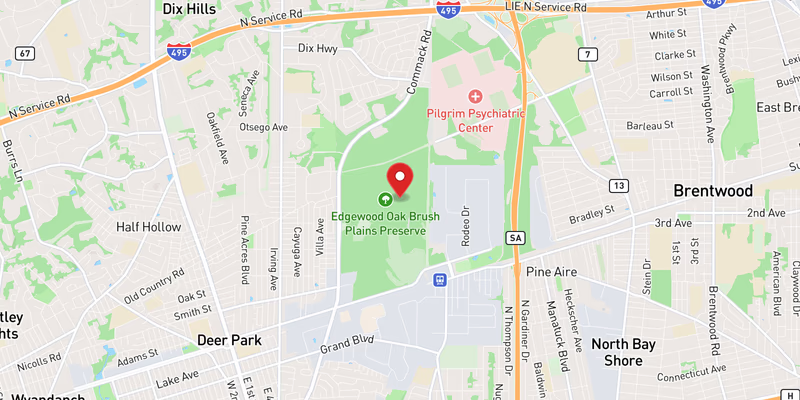
 Incident location, Long Island
What Happened
Tony Thomas, 59, of Far Rockaway, was struck and killed by an SUV while riding his bicycle on Beech Street near the intersection with Scott Drive in East Atlantic Beach at approximately 7:45 a.m. on March 24, according to Nassau County police. Firefighters pronounced Thomas dead at the scene. About three hours later, police located the vehicle and arrested the driver, Erin M. Henry, 67, of Long Beach, charging her with a felony for fleeing the scene of the fatal crash.
Henry pleaded not guilty to the charges, and her lawyer told Newsday “we feel horrible for the victim.” The crash occurred on a stretch of road where Nassau County Executive Bruce Blakeman’s administration had quietly canceled a long-planned protected pedestrian and bicycle path that was designed to improve safety for cyclists and pedestrians, according to residents, county lawmakers and planning documents reviewed by Newsday.
The fatal collision happened on a section of Beech Street where at least six people were injured in crashes during the year preceding Thomas’ death, with three of those injuries classified as serious, according to Newsday’s crash data analysis. While none of those previous crashes involved cyclists or pedestrians, one victim was an 11-year-old child who required airlift transport from the scene after a crash involving a drunk driver.
Atlantic Beach resident Kevin Kelley, 77, who primarily travels by bicycle, said he was initially horrified by the cyclist fatality but then became angry “because this road was supposed to be protected” by the shared-use path that had been planned for the area. Kelley described riding along Beech Street as having “always been crazy — people drive 55 miles an hour,” despite the posted speed limit of 25 mph.
The canceled infrastructure project would have created a protected path for cyclists and pedestrians separated from the roadway by a grassy strip, along with implementing a “road diet” that would have narrowed the street from four lanes to two lanes plus a turning lane. Traffic engineers say such lane reductions slow drivers down even when police enforcement isn’t present. Instead of the safety improvements, county contractors who began work last fall simply repaved the existing sidewalks and installed new drainage systems.
County spokesman Christopher Boyle did not respond to multiple requests for comment about the ongoing project, including why the protective path was eliminated from the construction plans. The repaved sidewalks that replaced the planned bike path are narrow in places and interrupted by telephone poles that force pedestrians to walk around them, according to observations during the ongoing construction work.
Location & Road Context
The fatal crash occurred on Beech Street in East Atlantic Beach, a thoroughfare that serves as a major connector between bay-side and beach-side communities in the area. The road features an S-curve configuration and has long been identified by residents as dangerous due to excessive speeds and poor pedestrian infrastructure.
Resident Jill Raftery, who lives just north of Beech Street in East Atlantic Beach, said she doesn’t allow her fifth-grade child to cross the street alone because “the roads around us are just so dangerous.” John Colletti, president of the East Atlantic Beach Taxpayers’ Association, described the street as “such a divider” that prevents the area from feeling like a cohesive neighborhood. The planned bike path would have connected communities on either side of the busy corridor.
Investigation & Legal Proceedings
Erin M. Henry faces felony charges for leaving the scene of the fatal crash that killed cyclist Tony Thomas. She was arrested approximately three hours after the 7:45 a.m. collision when police located her vehicle. Henry has pleaded not guilty to the charges, and her attorney expressed remorse for the victim while indicating they would contest the case. Newsday was unable to locate family members of Thomas for comment about the ongoing legal proceedings.
Broader Impact
The canceled bike path project represented more than a decade of community planning that began after Superstorm Sandy highlighted infrastructure vulnerabilities in the area. The original plan, first proposed in 2014 through a resident-driven committee process, carried an estimated cost of $5.5 million and was designed to address both flooding concerns and traffic safety issues that residents had identified around children’s school routes.
County Legislator Patrick Mullaney (R-Long Beach) said the Blakeman administration canceled the path and road diet before Mullaney assumed office in 2024, though he wasn’t provided clear explanations for the decision. His predecessor, former legislator Denise Ford, said the project had strong support in East Atlantic Beach but faced opposition from commuters who travel through the area and were concerned about potential traffic congestion.
The infrastructure changes would have relocated an existing “lane drop” about half a mile west to create space for the three-quarter-mile-long shared-use path along the south side of Beech Street, which becomes Park Street as it continues westward. Colletti argued that congestion concerns were overblown because the road already narrows to two lanes at the eastern end of where the road diet would have been implemented.
Ford said concerns about emergency vehicle access were raised and addressed during the original planning process, with county engineers consulting fire departments to ensure adequate space. If problems had emerged, she noted, corrections could have been made relatively easily without significant additional cost. Oscar Smith, East Atlantic Beach’s fire commissioner, said he remains concerned about crashes on Beech Street, including a vehicle that crashed into the wall of his own home last year.
The project evolved from a community planning process that included residents, engineers, and flood mitigation experts, resulting in a 2014 reconstruction plan that estimated the Beech Street improvements at $5.5 million. Under former County Executive Laura Curran’s administration, the county erected a billboard announcing the “complete streets and drainage” project, funded through a state grant. In 2022, the legislature mailed residents flyers featuring renderings of the planned shared-use path, stating the accompanying road diet would “promote reduced speeds and increase pedestrian safety.”
However, by the time construction began, county documents described the work only as a “drainage improvement” project with a total estimated cost of $11.3 million. Mullaney said he has worked with the current county administration to ensure the road will receive high-visibility crosswalks, blinking warning lights for drivers, and higher sidewalks to provide some pedestrian protection, though these measures fall short of the comprehensive safety improvements originally planned.