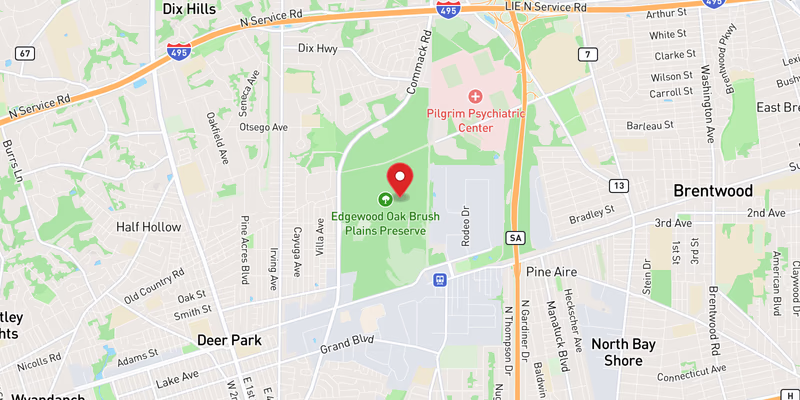
 Incident location, Long Island
What Happened
A Hauppauge man accused of driving drunk at more than twice the legal limit and killing an off-duty Nassau County police officer pleaded not guilty Friday to a sweeping set of upgraded charges, according to a News 12 Westchester report published March 13, 2026. Matthew Smith, 20, now faces a dozen new charges, including aggravated vehicular homicide, vehicular manslaughter, and aggravated vehicular assault, in connection with the death of Nassau County Police Officer Patricia Espinosa, 42.
The deadly crash took place at approximately 6 a.m. at the intersection of Alexander Avenue and Route 347, near the Smith Haven Mall in the Lake Grove area of Suffolk County. Espinosa was traveling westbound from her home in St. James toward the Nassau County Police Department’s Fifth Precinct in Elmont — where she had worked since 2017 — when Smith ran a red light and slammed into her vehicle without ever applying the brakes. Prosecutors say Smith was traveling at 70 mph at the moment of impact. Per the News 12 report, data recovered from Smith’s vehicle also showed he hit a top speed of 125 mph at some point during his drive before the fatal collision, and surveillance video captured him weaving in and out of traffic in the time leading up to the crash.
Smith’s blood-alcohol content was measured at .20 — more than twice New York State’s legal limit of .08, prosecutors said. In the hours before the crash, Smith had been drinking in downtown Patchogue. He and a passenger then got into his car and drove to Jake’s 58, the casino in Islandia, but were turned away because the establishment was closed overnight. The two then got back into Smith’s vehicle and began driving in the direction of the passenger’s home, a route that ultimately led to the fatal collision.
Prosecutors also revealed a particularly damning detail about Smith’s conduct at the bar prior to driving: other patrons had warned him not to get behind the wheel. Not only did he ignore those warnings, but he actively taunted them. “Not only did he disregard that, but he dangled the keys in everyone’s faces,” said Suffolk County District Attorney Ray Tierney at the arraignment Friday.
The human toll of the crash has reverberated deeply across Nassau County’s law enforcement community. Officer Espinosa’s husband, fellow Nassau County Police Officer Francisco Malaga, was among the first responders to arrive at the scene of the crash that killed his wife. The couple leaves behind a 2-year-old daughter, Mia. In the week between Espinosa’s death and Smith’s initial court appearance in early February, hundreds of police officers joined family and friends to pay their respects at her wake and funeral. Officers later packed the courtroom at Smith’s first arraignment, demanding justice for their fallen colleague.
Smith had initially appeared in court on February 6, 2026, where he pleaded not guilty to a single count of driving while intoxicated. Even at that early stage, however, the judge ordered that Smith be held on $1 million bail, in anticipation of a grand jury indicting him on significantly more serious charges — which is precisely what occurred in the weeks that followed.
Location & Road Context
The crash occurred at the intersection of Alexander Avenue and Route 347 near the Smith Haven Mall in Lake Grove, Suffolk County — a busy commercial corridor that sees heavy traffic at all hours. Route 347, also known as Nesconset Highway, is one of the primary east-west arterials through central Suffolk County, connecting communities from Port Jefferson Station through Hauppauge and Smithtown. The intersection sits in close proximity to one of Long Island’s largest shopping centers, making it a high-traffic zone even during early morning hours. Our local incident database contains 395 recorded accidents in Nassau County alone, reflecting the ongoing traffic safety challenges across Long Island’s major roadways.
Officer Espinosa’s route — from St. James westward toward Elmont — would have taken her along some of the Island’s most-traveled roads during what would have been a pre-dawn commute to her 6 a.m. shift. The intersection where the crash occurred was well within the range of active traffic camera and data infrastructure, which prosecutors say provided critical video evidence of Smith’s reckless driving in the moments before impact.
Investigation & Legal Proceedings
According to the News 12 Westchester report, a grand jury indicted Smith on a dozen upgraded charges following his initial February 6 appearance. Those charges now include aggravated vehicular homicide — the most serious of the counts — along with vehicular manslaughter and aggravated vehicular assault. Smith pleaded not guilty to all charges at his Friday arraignment.
The prosecution’s case is bolstered by multiple categories of evidence: vehicle data recovered from Smith’s car confirming his speed and driving pattern, surveillance video documenting his reckless behavior in the lead-up to the crash, and witness accounts from bar patrons who warned him against driving. Suffolk County District Attorney Ray Tierney personally addressed reporters outside the courtroom, underscoring the egregious nature of Smith’s conduct. Smith remains held on $1 million bail, which was set at his initial February appearance. If convicted on the top charge of aggravated vehicular homicide, Smith faces a sentence of eight and one-third to 25 years in state prison.
Broader Impact
Under New York State law, aggravated vehicular homicide is a Class B felony — among the most serious DWI-related charges that can be filed, typically reserved for cases involving a BAC of .18 or higher, prior DWI convictions, or particularly reckless driving behavior. Smith’s case involves all of the aggravating factors that elevate this charge to its most serious form: a BAC of .20, documented speeds exceeding 125 mph, running a red light without braking, and the death of a law enforcement officer. The case has drawn renewed attention to the consequences of drunk driving on Long Island’s roadways and to the resources available through New York’s Know Your Rights framework when crashes involve criminal charges.