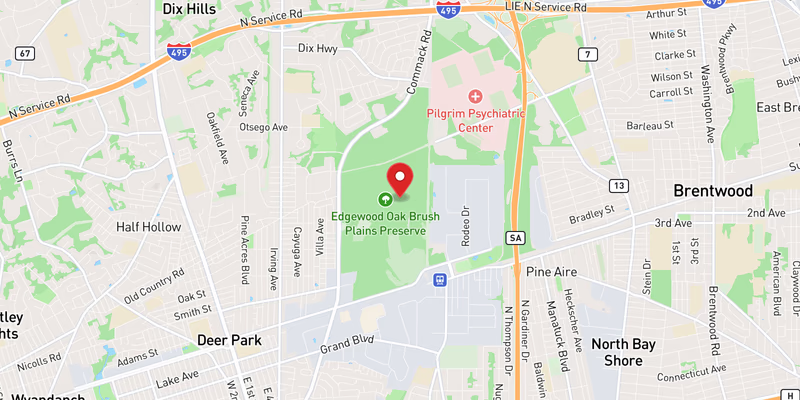
 Incident location, Long Island
What Happened
The fatal runway crash between a plane and truck at LaGuardia Airport on Sunday night that killed two pilots has heightened anxiety for travelers across Long Island, with passengers at MacArthur Airport expressing increased nervousness about flying despite aviation safety statistics. Jaislyn DiGiglio, 30, of Northport, who works in the yachting industry, found herself praying for safety on the morning of her flight from Long Island MacArthur Airport in Ronkonkoma to Palm Beach, Florida, this week as thoughts of the LaGuardia accident consumed her mind.
“I did think about it,” DiGiglio said. “Those two pilots that unfortunately passed away, I was thinking about them and their families, and my family. I’m recently married. All that ran through my head.” Despite her anxiety, canceling or postponing her flight was not an option since she needed to get to Florida for a yacht show. She coped by distracting herself with a book and praying “not only for myself but for every plane taking off today,” according to Newsday reports.
In the same Ronkonkoma airport waiting area, Sharmine Parsaud, 62, a lawyer from Seaford, said for the first time since the September 11, 2001 attacks, she was nervous about flying. “The recent event at LaGuardia gave me concern,” Parsaud said. “That’s an airport I generally fly out of when I go for business.” Parsaud was flying for pleasure rather than work, traveling to attend her father’s 90th birthday celebration. “It’s an event,” Parsaud said. “I didn’t want to miss it.”
The psychological impact of Sunday’s crash at LaGuardia, whose cause and chronology remain murky with effects still evident in major delays and runway closure, has triggered or rekindled anxiety over flying for some travelers despite commercial aviation’s strong safety record. In nearly 20 million flight hours for air carriers in the United States in 2024, the most recent year for which full data was available, the federal Bureau of Transportation Statistics recorded just 34 serious air accidents. The lifetime odds of dying as an aircraft passenger in the United States are “too small to calculate,” according to the nonprofit National Safety Council.
George Hodyno, a retired airline pilot from Elmont who flew out of MacArthur for decades and now lives in Henderson, Nevada, acknowledged the psychological impact accidents can have on nervous flyers. “If you do have anxiety about flying, after something like this, it’s probably intensified,” Hodyno said. During his flying career, he would stand in the jetway when passengers were boarding and field questions about turbulence, timing, and flight experience. “If I found a passenger with a lot of anxiety, I’d take them up into the cockpit, sit them down and explain exactly what we were going to do,” he explained.
Dr. Victor Fornari, director of child and adolescent psychiatry at Northwell’s Zucker Hillside Hospital, who treated survivors of Avianca Flight 052 which crashed in Glen Cove in 1990, said current global tensions are amplifying baseline anxiety levels. “The baseline anxiety level is high,” Fornari said. “Given current events, there’s a heightened sense of anxiety, given the current global situation with war and concerns about safety… People who are already anxious may be feeling even more anxious.”
Location & Road Context
Long Island MacArthur Airport in Ronkonkoma serves as a key regional airport for Long Island residents seeking alternatives to the New York City area’s major airports. The airport has become increasingly important for travelers like Parsaud, who typically uses LaGuardia for business travel but found herself departing from MacArthur following Sunday’s runway accident.
Workers on a lift were observed cutting away debris hanging from the wreckage of the Air Canada Express jet on Tuesday, two days after it collided with a Port Authority fire truck at LaGuardia Airport, according to reports. The ongoing cleanup and investigation has continued to impact operations at the Queens airport.
Investigation & Legal Proceedings
National Transportation Safety Board investigators are scrutinizing communications between the truck, plane and air traffic control, clearance procedures and the equipment and technologies that should have prevented the crash, according to Robert Joslin, associate professor at Embry-Riddle Aeronautical University in Daytona Beach, Florida. “They’ll drill down to a million other variables and this will get scrutiny,” Joslin said.
The investigation findings will likely lead to procedural improvements in aviation safety. “When these things have happened in the past, there’s procedural training, with special emphasis put into simulator training for pilots and making sure they reinforce training for vehicle operators,” Joslin explained.
Broader Impact
For travelers experiencing intense fear of flying, the physiological responses can include elevated pulse and blood pressure, hyperventilation, gastric distress and frequent panic attacks, according to a study by researchers at Charles University in Czechia. Hodyno’s advice for anxious flyers emphasizes communication: “Ask the crew… If there’s any anxiety about it, ask the question. We’d be happy to answer. Part of our job is passenger comfort. You want people to feel secure.” For many travelers, Fornari noted that something as simple as listening to music or engaging in light exercise can help manage anxiety, while those with especially intense fear may benefit from short-acting anti-anxiety medications like Xanax, Klonopin or Ativan. Flying strips away what Fornari called the “illusion of control” that many people maintain in their daily lives, making accidents like Sunday’s particularly unsettling for nervous passengers despite aviation’s exemplary safety record.