Lie May 14 #iee7ic: Large Sinkhole Swallows Car…

Large Sinkhole Swallows Car on Long Island Expressway, Closes Traffic Lanes. on lie. May 14, 2026.

Updated May 16, 2026
MINOR INCIDENT
Road
Lie
Reported
Updated
Source
News Sources
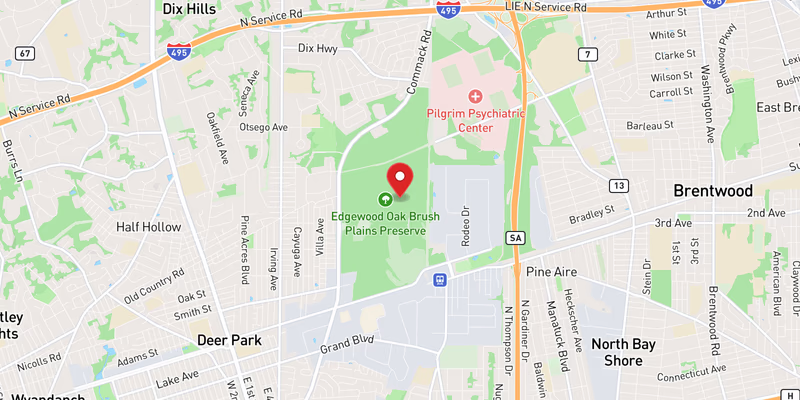
📌Approximate area — along Long Island Expressway Open in Google Maps →

Map showing incident location at 40.7800, -73.3000 Incident location, Long Island

What Happened

A large sinkhole opened on the Long Island Expressway on Thursday, May 14, 2026, swallowing a car and forcing the closure of multiple traffic lanes. NBC New York reported the dramatic incident that brought traffic to a standstill on one of the region’s busiest highways.

The sinkhole appeared suddenly on the roadway, creating a dangerous hazard for motorists traveling on the Long Island Expressway. According to NBC New York, the opening in the roadway was substantial enough to completely engulf a vehicle that was traveling through the area when the pavement gave way.

The incident necessitated immediate lane closures on the Long Island Expressway as authorities responded to secure the scene and assess the damage. Traffic was significantly impacted as vehicles were forced to navigate around the affected area while emergency crews worked to address the situation.

Details about the driver of the affected vehicle, including their condition and any potential injuries, were not immediately available in the initial reports. The cause of the sinkhole formation and the specific location along the Long Island Expressway were also not specified in the preliminary coverage of the incident.

Emergency response teams quickly mobilized to the scene to manage both the traffic situation and the infrastructure failure. The sudden appearance of such a large sinkhole on a major thoroughfare like the Long Island Expressway represents a significant safety concern for the thousands of drivers who use this route daily.

Location & Road Context

The Long Island Expressway serves as one of the primary east-west arteries for Long Island traffic, carrying hundreds of thousands of vehicles daily between New York City and eastern Long Island communities. The highway spans approximately 71 miles from the Queens-Midtown Tunnel to Riverhead, making it a critical transportation link for commuters, commercial traffic, and travelers.

According to Long Island Traffic records, the I-495 corridor has experienced 698 recorded incidents in our database, highlighting the ongoing challenges faced along this heavily traveled route. Recent incidents in the area have included multiple roadwork operations and construction projects, suggesting ongoing infrastructure maintenance needs along the expressway. The appearance of a sinkhole adds another dimension to the safety and maintenance concerns for this vital transportation corridor.

Authorities are expected to conduct a thorough investigation into the cause of the sinkhole formation, including examining the underlying infrastructure and any potential contributing factors. The New York State Department of Transportation will likely be involved in assessing the roadway integrity and determining the necessary repairs to restore normal traffic flow.

The incident will require coordination between multiple agencies to address both the immediate safety concerns and the longer-term infrastructure repairs needed to prevent similar occurrences. Engineers and road safety specialists will need to evaluate the extent of the subsurface damage and develop appropriate remediation strategies.

Broader Impact

This sinkhole incident on the Long Island Expressway underscores the ongoing infrastructure challenges facing aging roadway systems throughout the region. The sudden appearance of such road failures can create serious safety hazards and significant traffic disruptions for the hundreds of thousands of daily commuters who rely on this critical transportation route. The incident serves as a reminder of the importance of regular infrastructure monitoring and maintenance to prevent potentially dangerous road conditions from developing unexpectedly.

Topics

LieLong Island accident todayLong Island traffic todayLong IslandNY

Frequently Asked Questions

What should I do if I'm in a car accident Lie?

Call 911 immediately if anyone is injured or if the vehicles can't be moved safely off the roadway. Stay at the scene — leaving the scene of an accident with injuries is a crime under New York Vehicle and Traffic Law §600. Exchange license, registration, and insurance information with every other driver involved. Take photographs of every vehicle, the position of the vehicles before they're moved, all license plates, the road surface, traffic signs, and any visible injuries. Get the names and phone numbers of every witness — police often won't capture bystander witnesses on their own. Seek medical attention within 24 hours even if you feel fine; soft-tissue injuries and concussions can take a day or two to present, and a delayed medical visit weakens an injury claim. In Nassau County, NCPD responds outside of incorporated villages. In Suffolk County, SCPD covers the five western towns; East End towns have their own forces. New York State Police Troop L responds to accidents on state highways across both counties.

How long do I have to file a no-fault claim in New York?

Thirty days. New York Insurance Law §5102 requires you to file a Personal Injury Protection (PIP/no-fault) application with the insurer of the vehicle you were in (or, if you were a pedestrian or cyclist, with the insurer of the striking vehicle) within 30 days of the accident. Missing the 30-day deadline can void your no-fault benefits — that's up to $50,000 in medical bills and 80% of lost wages (capped at $2,000/month) per injured person. The form is the NF-2 application; your insurance carrier provides it on request. New York no-fault is a true PIP system: it pays regardless of who caused the crash.

How long do I have to sue after a Long Island car accident?

Three years from the date of the accident for personal injury claims under CPLR §214(5). Wrongful death claims have a two-year deadline under EPTL §5-4.1. If a government entity is involved (a county vehicle, a road defect on a state highway, a defective traffic signal, a county bus), you must file a Notice of Claim within 90 days under General Municipal Law §50-e — that's a non-negotiable jurisdictional deadline, and missing it usually bars the claim entirely. Property-damage-only claims have the same three-year clock. The clock starts on the day of the accident, not the day you discover the full extent of an injury.

How do I get a copy of the police accident report?

If local police responded to the scene, the report is filed under an MV-104A form. In New York State, you can request a copy through the DMV at https://dmv.ny.gov/vehicle-safety/get-copy-accident-report (roughly $7 online, $10 by mail) once the responding agency has uploaded it to the state system, which usually takes 5-10 business days. NCPD and SCPD also have their own direct-request processes through the precinct that responded. If you weren't injured but the property damage exceeded $1,000, New York VTL §605 requires you (the driver) to file your own MV-104 report with the DMV within 10 days regardless of whether police responded.

How dangerous is Lie ?

Long Island Traffic tracks every reported incident on this road across both counties — see the road profile page for the multi-year accident count, severity distribution, and the specific intersections that show repeated incident clusters. Suffolk and Nassau county roads with chronic problems are reviewed by their respective DOTs on a multi-year cadence; persistent issues are sometimes addressed with new signal phasing, lane-narrowing treatments, or — in extreme cases — a Vision Zero engineering response. Daily incident updates flow into our live-events feed every fifteen minutes.

Disclaimer: Incident information on this page is compiled from public sources including police reports, traffic agencies, and news outlets. It is provided for informational purposes only and may not reflect the most current status of this incident. Do not rely on this information for legal, insurance, or emergency decisions. For emergencies, call 911.