Location: Lexington Avenue, Long Island
What Happened
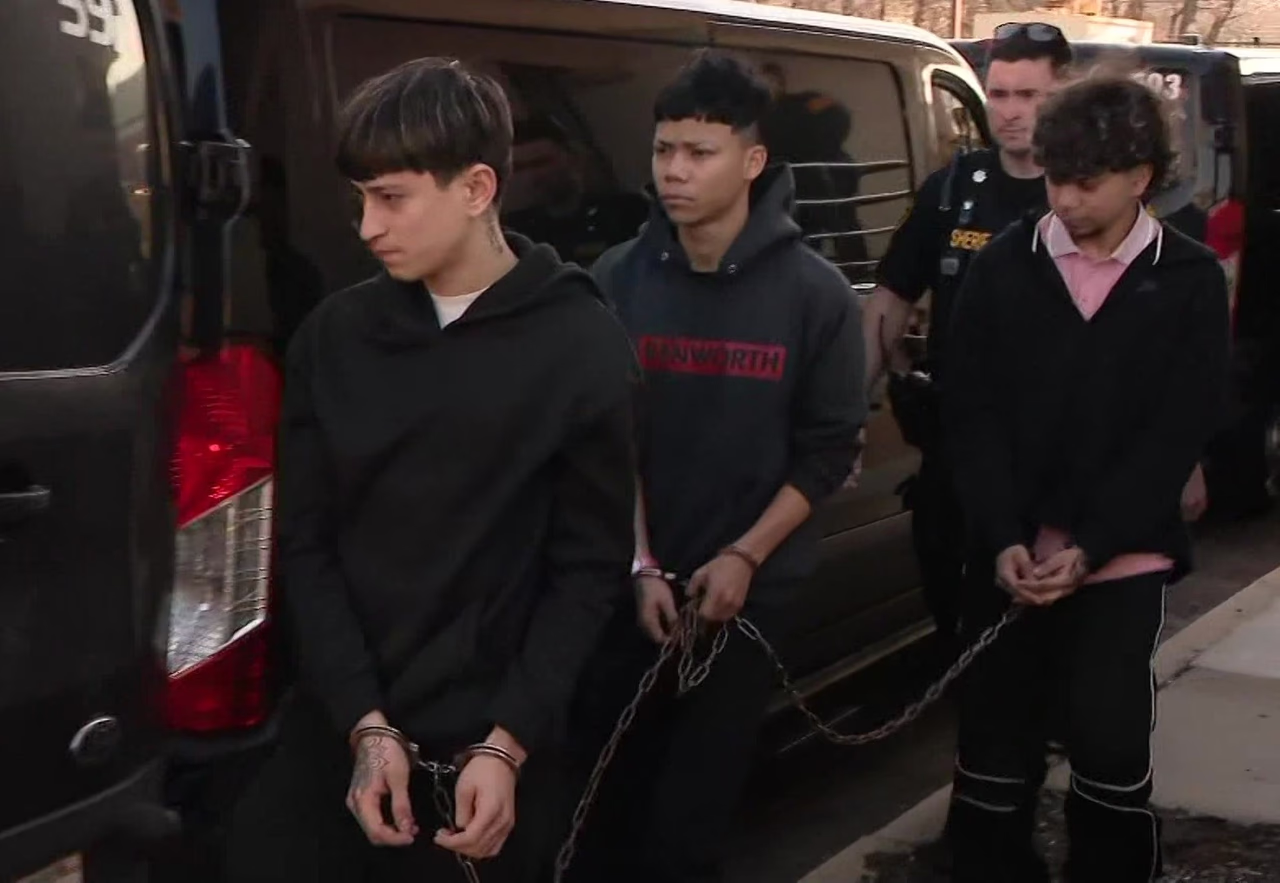
Four defendants have been indicted in Suffolk County after prosecutors said they allegedly planned to firebomb a vehicle in Brentwood using homemade Molotov cocktails. The case was announced by the Suffolk County District Attorney’s Office on May 27, 2026, and was later republished by LongIsland.com.
The defendants identified by prosecutors are Elvis Osvaldo Romero Martinez, 20; Albert Yanes Moran, 20; Lorenzo Nohely Alvarado Navarette, 18; and Lester Merino Avila, 18. The DA’s office said the men were indicted on conspiracy-related charges after investigators alleged they acquired materials for two incendiary devices and planned to use them against a vehicle belonging to someone connected to a dispute.
The allegations remain pending in court. All four defendants are presumed innocent unless and until proven guilty.
Timeline of the Alleged Plot
According to Suffolk prosecutors, the alleged conspiracy took shape between March 9 and March 10, 2026. Investigators say the group acquired materials to build homemade Molotov cocktails and then met in the area of Pilgrim Psychiatric Center in Brentwood during the early morning hours of March 10.
The DA’s office said the devices were allegedly prepared with beer bottles and gasoline. Prosecutors further alleged that Merino Avila drove toward Lexington Avenue in Brentwood with another person to locate the intended target vehicle, while Romero Martinez, Yanes Moran, and Alvarado Navarette followed in a separate car.
At about 1:38 a.m., a Suffolk County police officer conducted a traffic stop near Lexington Avenue and Caleb’s Path in Brentwood. Prosecutors said Romero Martinez, who was allegedly driving, moved from the driver’s seat into the back seat as the stop unfolded.
What Police Allegedly Found
The DA’s office said the officer observed two Molotov cocktails in the rear driver’s side door area, along with a canister of gasoline. During a further vehicle search, investigators allegedly recovered a mask and lighter from a bag that prosecutors connected to Yanes Moran.
Prosecutors also said cell phones recovered from several defendants allegedly contained conversations about planning the attack and obtaining materials. That combination of alleged physical evidence and digital communications is now central to the indictment.
No injuries were reported, and prosecutors did not report that the target vehicle was actually burned. Based on the DA’s announcement, the case concerns an alleged planned attack that law enforcement says was interrupted before the firebombing occurred.
Charges and Court Dates
Romero Martinez, Alvarado Navarette, and Yanes Moran were arraigned on May 26, 2026 before Acting Supreme Court Justice Richard I. Horowitz. Prosecutors said they were charged with Conspiracy in the Fourth Degree, Criminal Possession of a Weapon in the Third Degree, and Conspiracy in the Fifth Degree.
Merino Avila was arraigned on May 27, 2026 on Conspiracy in the Fourth Degree and Conspiracy in the Fifth Degree, according to the DA’s office.
The DA’s office said Romero Martinez, Yanes Moran, and Merino Avila are due back in court on June 17, 2026. Alvarado Navarette is due back on June 18, 2026.
Bail Reform Issue Raised by Prosecutors
Suffolk County District Attorney Raymond A. Tierney used the announcement to criticize New York’s bail framework, saying prosecutors could not request bail because the charged offenses were not bail-eligible under current law. The DA’s office said all four defendants were released after arraignment.
That release is not an acquittal or dismissal. It means the defendants remain out of custody while the criminal case proceeds, subject to whatever conditions the court imposed. The underlying allegations will still have to be proven in court.
Brentwood Context
The alleged final stage of the plan occurred near Lexington Avenue and Caleb’s Path in Brentwood, a residential Suffolk County community with major access routes feeding toward Crooked Hill Road, Suffolk Avenue, Wicks Road, and the Long Island Expressway corridor. Even when a case does not involve a road closure or crash, an alleged planned vehicle firebombing creates obvious public-safety risks: fire spread, explosion risk, secondary injuries, property damage, and emergency-response disruption in a populated neighborhood.
For drivers and residents, the key practical point is that this was not reported as an active traffic incident by the time of the indictment. It is a criminal case arising from a March 10 police stop and alleged planned attack, updated after grand jury proceedings in late May 2026.
Sources
This report is based on the Suffolk County District Attorney’s May 27 announcement, the May 28 LongIsland.com republication, and News 12 Long Island’s coverage of the indictment and release issue. Long Island Traffic rewrote and structured the report for local traffic and public-safety context; no source text is reproduced verbatim beyond short attributed names, charges, and location facts.