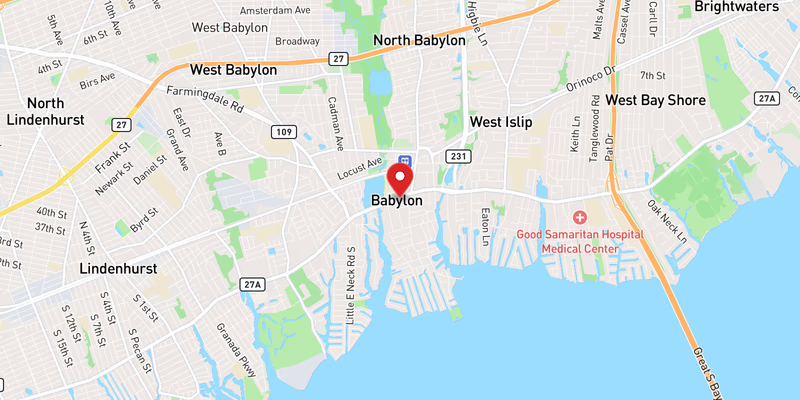
 Incident location, Long Island
What Happened
Switch trouble at Babylon station snarled Long Island Rail Road Babylon branch service on the morning of Saturday, May 30, 2026, producing delays of 15 to 25 minutes and forcing the cancellation of multiple trains, according to News 12 Long Island. The disruption affected riders system-wide on the branch through the late-morning hours before the MTA was ultimately able to bring the situation under control.
According to News 12 Long Island, the MTA confirmed that the specific mechanical problem involved a faulty switch located at Babylon station itself. Track switches are critical infrastructure components that physically guide rail cars from one set of tracks to another — when one malfunctions at a hub station like Babylon, the effects can ripple outward across every train movement passing through that point, triggering a cascade of late arrivals, missed connections, and cancelled runs throughout the entire branch.
The MTA reported that the switch trouble was resolved at 12:21 p.m. on Saturday. The article published by News 12 Long Island was timestamped at 12:57 p.m. on May 30, 2026, meaning the resolution was confirmed approximately 36 minutes before the report went live — giving late-morning and early-afternoon commuters some relief heading into the remainder of the holiday weekend. No injuries were reported as a result of the service disruption, and no emergency response was required beyond the MTA’s own mechanical and operations crews working to restore normal switch function.
Riders who encountered delays or cancellations during the incident were directed by the MTA to visit mta.info for real-time updates on service status, train cancellations, and alternative routing options. The MTA’s website serves as the primary hub for official LIRR service alerts and is updated continuously during active service disruptions across all branches.
No additional details about the duration of the morning disruption window — specifically when the switch trouble first began — were included in the MTA’s public statements or in the News 12 report. It is clear, however, that the issue was active during what would typically be a busy Saturday morning travel period on a branch that serves some of Long Island’s most densely populated South Shore communities, including communities in and around Babylon township.
Location & Road Context
The Babylon branch of the Long Island Rail Road is one of the busiest and most heavily used commuter rail corridors on Long Island, running along the South Shore and connecting communities from Penn Station in Manhattan through Jamaica, Valley Stream, Freeport, Merrick, Bellmore, Wantagh, Seaford, Massapequa, Amityville, Copiague, Lindenhurst, and Babylon, among others. Babylon station serves as a critical junction and terminus point for many branch trains, making any mechanical failure there especially impactful for the entire line.
Switch trouble at a terminal station like Babylon is particularly disruptive because trains must change tracks there to begin their return journeys or to be staged for incoming service. A malfunctioning switch at that location can effectively bottle up train movements in both directions, compounding delays far beyond the immediate repair site. Riders traveling to and from towns along the Babylon branch on a Saturday morning — whether heading to work, recreational destinations, or connecting to other transit — would have faced an unpredictable and frustrating commute during the disruption window.
Broader Impact
Switch-related mechanical failures have historically been among the most common causes of LIRR service disruptions, and incidents on the Babylon branch — one of the railroad’s most heavily trafficked corridors — tend to affect a large number of riders even when resolved within a few hours. Riders who depend on the LIRR for weekend travel on the South Shore are encouraged to bookmark mta.info and sign up for MTA service alerts specific to the Babylon branch so that future disruptions can be flagged before they affect travel plans. For a full history of recent traffic and transit incidents on Long Island, Long Island Traffic maintains a continuously updated log of service disruptions, crashes, and road closures across the region.