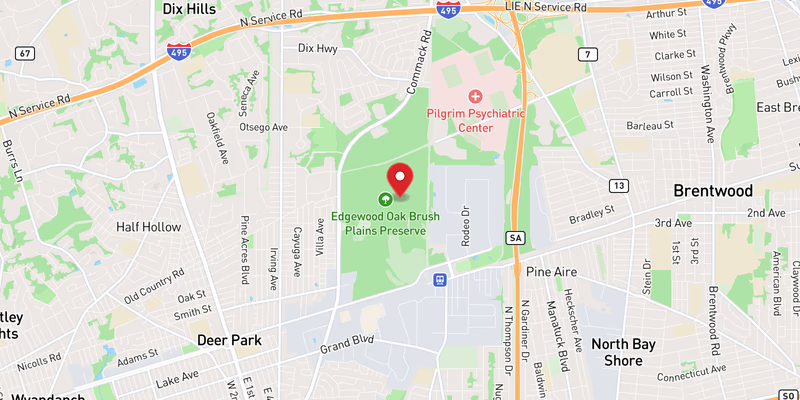
 Incident location, Long Island
What Happened
A driver was arrested on a DWI charge on Long Island on Sunday, June 7, 2026, according to incident data logged by authorities. The event has been classified as a major-severity incident, suggesting a serious outcome — but as of this writing, police have not yet publicly released the specific road, town, cross-street, or mile marker where the arrest occurred.
Critical details remain limited at this stage. The name, age, and hometown of the person charged have not been publicly disclosed. It is not yet confirmed whether a collision took place, whether other vehicles were involved, or whether any injuries were sustained. The time of the arrest has also not been released, though DWI arrests on Long Island occur disproportionately during late-night and early-morning hours on weekends, particularly on Sunday mornings following Saturday nights — a pattern documented repeatedly in Suffolk County Police Department and Nassau County Police Department arrest records.
Police have not yet confirmed the blood-alcohol content (BAC) reading involved, the type of vehicle driven, or the direction of travel at the time of the stop or crash. Whether a field sobriety test, breathalyzer, or blood draw was administered has not been publicly stated. Long Island Traffic will update this report as official information is released.
The major severity classification is notable. Under the 511NY incident classification system, a “major” designation typically indicates either significant injuries, lane closures requiring substantial emergency response, or both. Whether that severity reflects a collision or the nature of the arrest itself — including a potential refusal of chemical testing or a high BAC reading — police have not yet confirmed.
Location & Road Context
No specific road or municipality has been confirmed in this incident record. Long Island encompasses two counties — Nassau and Suffolk — and thousands of lane-miles of roadway ranging from high-speed expressways like the Long Island Expressway (I-495) and the Southern State Parkway to local county roads and village streets. Each carries its own speed limits, traffic enforcement patterns, and crash history.
Long Island Traffic maintains road-by-road crash and incident histories across the Island. Once a specific road is confirmed, this article will be updated with relevant traffic volume, crash frequency, and prior DWI incidents on that corridor.
Investigation & Legal Proceedings
No arraignment date, court venue, or bail information has been released at this time. Based on standard New York State criminal procedure, a person arrested on a DWI charge in Nassau County would typically be arraigned at the relevant Nassau County District Court, while a Suffolk County arrest would proceed through one of Suffolk’s district courts. Police have not yet confirmed which county or court has jurisdiction in this case.
Long Island Traffic is tracking this case and will publish updates when arraignment information, a not-guilty or guilty plea, or sentencing details become part of the public record.
What This DWI Charge Means
New York’s driving-while-intoxicated laws are codified under Vehicle and Traffic Law (VTL) §1192 and carry penalties that escalate based on BAC level and prior offenses. A DWAI (Driving While Ability Impaired) charge applies when a driver’s BAC is between 0.05 and 0.07, or when impairment by drugs is suspected; it is a traffic infraction, not a crime, for a first offense. A standard DWI charge requires a BAC of 0.08 or higher and is a misdemeanor on a first offense, carrying fines of $500–$1,000, a minimum six-month license revocation, and up to one year in jail. An Aggravated DWI applies when BAC reaches 0.18 or above, with steeper fines ($1,000–$2,500), a minimum one-year revocation, and mandatory ignition interlock device installation upon relicensure.
For repeat offenders, the stakes rise sharply. A second DWI within ten years becomes a Class E felony, and a third offense is a Class D felony, each carrying potential multi-year prison sentences, longer revocations, and higher fines. Mandatory ignition interlock devices are required for all DWI convictions in New York, including first-time offenders. Because the specific charge level in this case has not been confirmed, it is not yet known which tier of VTL §1192 applies here.
Drivers who refuse a chemical test in New York face automatic civil penalties separate from any criminal charge: a $500 civil penalty and an 18-month license revocation for a first refusal, with higher penalties for subsequent refusals. Refusal evidence can also be introduced against a defendant at trial. Whether a refusal occurred in this case has not been confirmed by police.
Case Status & Updates
It is important to note that an arrest or charge is an accusation only. The person charged in this incident is presumed innocent unless and until proven guilty in a court of law. No conviction has been entered, and no facts beyond the charge classification have been officially confirmed.
This case is expected to proceed through the New York district court system serving the relevant Long Island county once a location is confirmed. Long Island Traffic tracks DWI cases on Long Island through the courts and updates each report with arraignment outcomes, pleas, and sentencing results as they become part of the public record. Readers with information about this incident are encouraged to check back for updates.