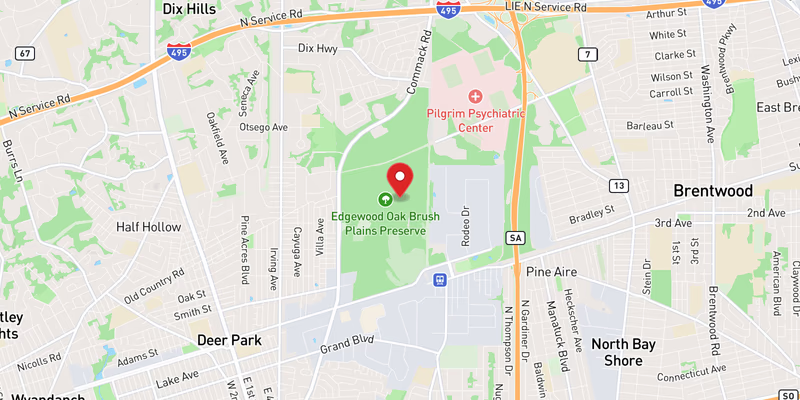
 Incident location, Long Island
What Happened
A driver was arrested on a DWI charge on Long Island, New York, on Thursday, June 11, 2026, according to available incident records. The arrest is classified as a major-severity event, indicating the situation was treated as a significant incident by first responders — though what specifically elevated it to that classification has not yet been confirmed by authorities.
Details remain extremely limited at this stage. The specific road, direction of travel, town, and precise location of the arrest have not been publicly identified by the responding agency. It is not yet known whether the incident involved a collision, a traffic stop, or another type of police encounter. The make, model, and year of the vehicle involved have not been released, nor has the time of day the arrest occurred.
The identity of the person charged — including their name, age, and hometown — has not been published in any official press release as of this writing. Police have not yet released the individual’s blood alcohol content (BAC), the specific subsection of New York Vehicle and Traffic Law §1192 under which they were charged, or whether any additional charges were filed. It is also not yet known whether any other individuals — passengers, pedestrians, or occupants of other vehicles — were involved or injured.
Long Island Traffic is actively monitoring this case. This article will be updated as soon as official information is released by the relevant law enforcement agency, whether that is the Nassau County Police Department, the Suffolk County Police Department, or the New York State Police.
Location & Road Context
Because the precise road and town have not been confirmed, specific road statistics cannot be provided at this time. Long Island’s road network spans two counties — Nassau and Suffolk — and includes some of the most heavily traveled corridors in New York State, including the Long Island Expressway (I-495), the Northern and Southern State Parkways, Sunrise Highway (NY-27), and Jericho Turnpike (NY-25), all of which have documented histories of impaired-driving incidents. When location details are confirmed, Long Island Traffic will add full road context, traffic volume data, and cross-street information to this report.
Readers can track live traffic conditions across Long Island at 511NY, the official New York State traffic information platform.
Investigation & Legal Proceedings
An arrest and charge on DWI grounds in New York initiates a formal criminal process. The accused would typically be processed and held pending arraignment, which in Nassau and Suffolk counties generally occurs within 24 hours of arrest at the relevant district court. Police have not yet released information on bail, release status, or the arraignment date for this individual.
The specific charge level has not been confirmed. Under New York law, impaired-driving charges range from a traffic infraction (DWAI, BAC between 0.05 and 0.07) up to a misdemeanor (DWI, BAC 0.08 or above) or a more serious misdemeanor (Aggravated DWI, BAC 0.18 or above). Each level carries distinct criminal and administrative consequences, detailed in the section below.
What This DWI Charge Means
New York’s impaired-driving statute, Vehicle and Traffic Law §1192, establishes three primary tiers of offense. A DWAI (Driving While Ability Impaired) charge — the least severe — is a traffic infraction, not a crime, typically triggered when a driver’s BAC falls between 0.05 and 0.07. A standard DWI charge applies at a BAC of 0.08 or above and is a misdemeanor on a first offense, carrying fines of $500–$1,000, a minimum six-month license revocation, and up to one year in jail. Aggravated DWI, triggered at a BAC of 0.18 or above, carries steeper first-offense fines of $1,000–$2,500 and a minimum one-year license revocation. All DWI convictions at the misdemeanor level or above require installation of an ignition interlock device on any vehicle the convicted person owns or operates.
Repeat offenses escalate dramatically. A second DWI conviction within ten years becomes an E felony under New York law, with fines reaching $5,000 and potential imprisonment of up to four years. A third conviction within ten years is a D felony, carrying fines up to $10,000 and up to seven years in prison. The DMV consequences of refusing a chemical test are also significant and automatic: a first refusal results in an immediate 12-month license revocation and a $500 civil penalty, separate from any criminal case outcome — even if charges are later reduced or dismissed.
Because the specific charge level in this case has not yet been confirmed by police, it is not yet known which tier of §1192 applies to the accused.
Case Status & Updates
It is important to emphasize that an arrest or charge is an accusation, not a conviction. The individual charged in this incident is presumed innocent under New York law and the United States Constitution until and unless proven guilty in a court of law.
This case is expected to proceed through the Long Island criminal court system, beginning with arraignment at the relevant New York district court — most likely in either Nassau County District Court or one of the Suffolk County district courts, depending on where the arrest occurred. Long Island Traffic tracks DWI cases through the local court system and updates each report with arraignment outcomes, entered pleas, any plea agreements, and final sentencing as they become part of the public record. Readers can check back on this page for the latest developments, and can browse other DWI and impaired-driving cases on Long Island in our ongoing coverage archive.