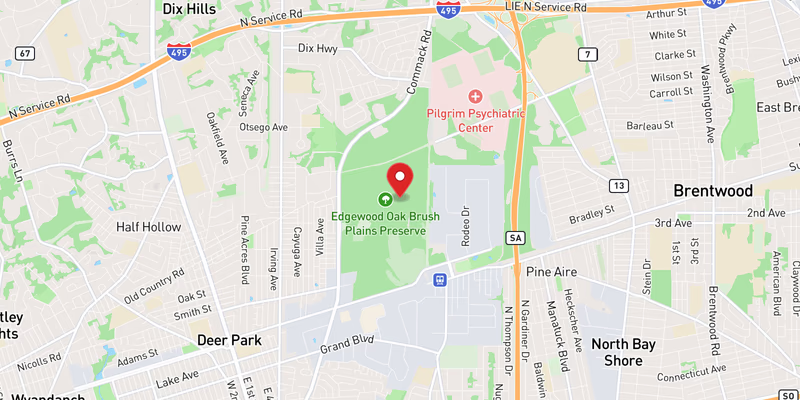
 Incident location, Long Island
What Happened
A driver was taken into custody on a DWI charge on Long Island on Saturday, June 13, 2026, according to an official incident record classified as major severity. Beyond those core facts, details remain limited — the specific road, town, time of day, and circumstances leading to the arrest have not yet been released by the responding agency.
It is not yet known whether the DWI arrest stemmed from a traffic stop, a crash, or a report from another motorist. Police have not yet confirmed the name, age, or hometown of the person charged, nor whether any other vehicles, pedestrians, or passengers were involved. The severity classification of “major” in the source record may indicate that injuries occurred or that a collision with significant property damage took place, but police have not yet confirmed either detail.
No official press release had been issued at the time of this report’s publication. Long Island Traffic is monitoring law enforcement channels and will update this article with the full incident narrative — including the responding agency, location, time, charges, and any victims — as soon as that information becomes available.
Location & Road Context
The incident was logged as occurring on Long Island, New York, encompassing Nassau and Suffolk counties, a region that consistently ranks among the state’s most active corridors for impaired-driving enforcement. Long Island’s road network includes major arteries such as the Long Island Expressway (I-495), Northern State Parkway, Southern State Parkway, and numerous county and local roads that see heavy weekend overnight traffic — the window most associated with DWI incidents statewide.
No road statistics are available for this specific report. Once the exact location is confirmed, Long Island Traffic will provide targeted context on crash history at or near that corridor.
Investigation & Legal Proceedings
An arrest and charge constitute an accusation under New York law. The person charged is presumed innocent until proven guilty in a court of law. Based on the available record, the case is expected to be arraigned at the local New York district court with jurisdiction over the arrest location and will proceed through Long Island’s criminal court system. Long Island Traffic tracks DWI cases through the courts and will update this report with arraignment outcomes, pleas, and sentencing as they become part of the public record.
The specific charge level — and therefore the exact legal exposure — has not yet been confirmed by police. Depending on the blood alcohol content (BAC) reading and the driver’s prior record, prosecutors may pursue charges ranging from a standard DWI to Aggravated DWI. See the section below for a breakdown of what each charge level means under New York law.
What This DWI Charge Means
New York’s Vehicle & Traffic Law (VTL) §1192 creates a tiered system of impaired-driving offenses. At the lowest level, Driving While Ability Impaired (DWAI) — a traffic infraction, not a crime — applies when a driver’s ability is impaired by alcohol but their BAC is below 0.08. A standard DWI charge requires a BAC of 0.08 or higher and is a misdemeanor on a first offense. Aggravated DWI is charged when BAC reaches 0.18 or higher and carries significantly steeper penalties even for a first-time offender. Because the specific charge level in this case has not yet been confirmed, it is not yet known which tier applies here.
For a first-offense standard DWI in New York, potential consequences include fines of $500–$1,000, a minimum six-month license revocation, a mandatory DMV driver responsibility assessment of $250 per year for three years, and a possible jail term of up to one year. A mandatory ignition interlock device is required upon any license restoration. Aggravated DWI on a first offense raises fines to $1,000–$2,500 and extends the minimum revocation period to one year. Repeat offenses within ten years elevate the charge to a felony, with substantially higher fines and mandatory state prison exposure.
Drivers in New York who refuse a chemical test (breathalyzer or blood draw) face automatic civil consequences under the state’s implied consent law: an immediate one-year license revocation and a $500 civil penalty on a first refusal — separate from and in addition to any criminal penalties. A refusal cannot be used as a complete defense but may be introduced as evidence of consciousness of guilt at trial.
Broader Impact
The “major severity” classification assigned to this incident by the reporting agency suggests this was not a routine traffic stop, though police have not yet confirmed whether a collision or injuries occurred. If injuries are confirmed, the charge level and sentencing exposure for the driver could increase substantially — New York law provides for elevated DWI charges, including felony assault, when impaired driving causes physical harm to another person.