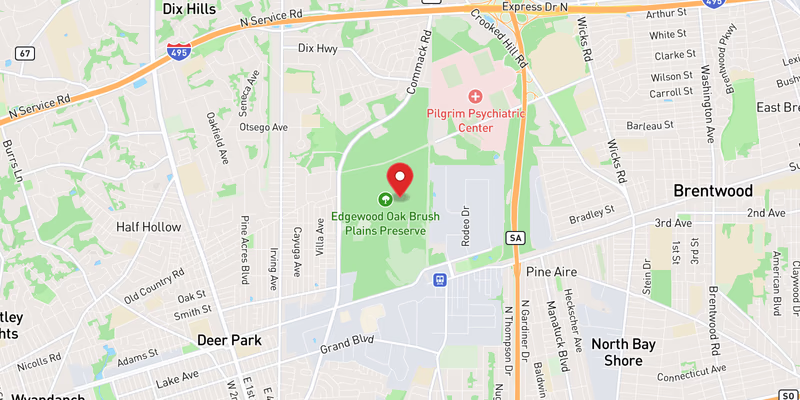
 Incident location, Long Island
What Happened
A driver was arrested on a driving while intoxicated charge on Long Island on Saturday, June 20, 2026, according to an official incident record flagged as major in severity. Beyond the date, the broad geographic designation of Long Island, and the DWI classification, details remain limited at this stage — police have not yet publicly confirmed the driver’s name, age, hometown, or the specific town and road where the stop or crash occurred.
The incident has been categorized as a major-severity event, which typically indicates a serious collision, significant injury, or aggravated circumstances — but police have not yet confirmed which of those factors applies here. It is not yet known whether this DWI arrest resulted from a traffic stop, a crash involving other vehicles, or a single-vehicle incident. The exact time of the arrest on Saturday night — or whether it occurred during daytime hours — has also not been released.
No responding agencies have been publicly named in connection with this report as of publication. Long Island is served by several law enforcement jurisdictions, including the Nassau County Police Department, the Suffolk County Police Department, and the New York State Police, any one of which could have handled this arrest depending on the location. Long Island Traffic will attribute the arrest to the correct agency once a press release or official confirmation is issued.
Readers with firsthand information about this incident are encouraged to check back as this report is a developing story. No external news outlets — including Newsday, News 12 Long Island, or local Patch affiliates — had published coverage of this specific incident at the time of this report’s publication, which limits independent corroboration of the available details.
Location & Road Context
The incident is recorded only as occurring on Long Island, New York — a region that encompasses Nassau County and Suffolk County, hundreds of miles of state, county, and local roads, and dozens of municipalities. Without a confirmed road name or town, it is not possible to provide specific road statistics or context at this time.
Long Island’s roadway network includes high-volume corridors such as the Long Island Expressway (I-495), the Northern State Parkway, the Southern State Parkway, and Sunrise Highway, all of which see significant DWI enforcement activity — particularly on weekend nights. Once the specific location is confirmed, Long Island Traffic will update this section with the relevant road data, traffic volume context, and any history of prior incidents at or near the scene.
Investigation & Legal Proceedings
An arrest on a DWI charge has been made, but police have not yet released arraignment information, bail status, or the name of the court where this case will be heard. In New York, DWI arrests are typically arraigned at the local district court in the town or village where the incident occurred — in Nassau County, that would be one of the district courts under the Nassau County District Court system, and in Suffolk County, one of the town justice courts or the Suffolk County District Court.
Long Island Traffic tracks DWI cases through the courts and updates each report with arraignment outcomes, pleas, and sentencing information as they become part of the public record. An arrest and charge are an accusation only — the person charged is presumed innocent until proven guilty in a court of law.
What This DWI Charge Means
New York’s Vehicle and Traffic Law §1192 establishes several tiers of impaired-driving offenses. A DWAI (Driving While Ability Impaired) charge applies when a driver’s BAC is between 0.05% and 0.07%, or when impairment by drugs is alleged; it is a traffic infraction, not a misdemeanor. A standard DWI charge applies at a BAC of 0.08% or higher and is a misdemeanor for a first offense, carrying fines of $500–$1,000, a minimum six-month license revocation, and up to one year in jail. An Aggravated DWI charge — BAC of 0.18% or higher — carries steeper fines of $1,000–$2,500 and a minimum one-year license revocation for a first offense. The specific charge level in this case has not yet been confirmed by police.
For repeat offenders, the consequences escalate significantly. A second DWI conviction within ten years is a Class E felony, with fines up to $5,000 and potential imprisonment of up to four years. All DWI convictions in New York trigger a mandatory ignition interlock device requirement for at least six months. Drivers convicted of Aggravated DWI or repeat offenses may face longer interlock periods and mandatory participation in the New York State Drinking Driver Program (DDP).
Drivers who refuse a chemical test — such as a breathalyzer or blood draw — face automatic consequences under New York’s implied consent law, separate from any criminal charges. A first refusal results in an immediate 12-month license revocation and a $500 civil penalty. A second refusal within five years carries an 18-month revocation and a $750 penalty. Refusal can also be used as evidence against a defendant in criminal court proceedings.
Case Status & Updates
This case is in its earliest stages, and Long Island Traffic will continue to monitor it as it moves through the court system. Once the identity of the arrested driver, the specific charges, and the arraignment court are confirmed through official sources, this report will be updated accordingly.
It bears repeating: a DWI charge is an accusation, not a conviction. The individual arrested is entitled to the presumption of innocence under New York law and the United States Constitution. Long Island Traffic reports on DWI arrests as matters of public record and public safety — not as determinations of guilt.
For ongoing coverage of DWI arrests on Long Island, including case outcomes and sentencing updates, bookmark Long Island Traffic’s DWI tracker. If you or someone you know has been involved in a crash, visit our Know Your Rights page for guidance on navigating the aftermath of a traffic incident on Long Island.