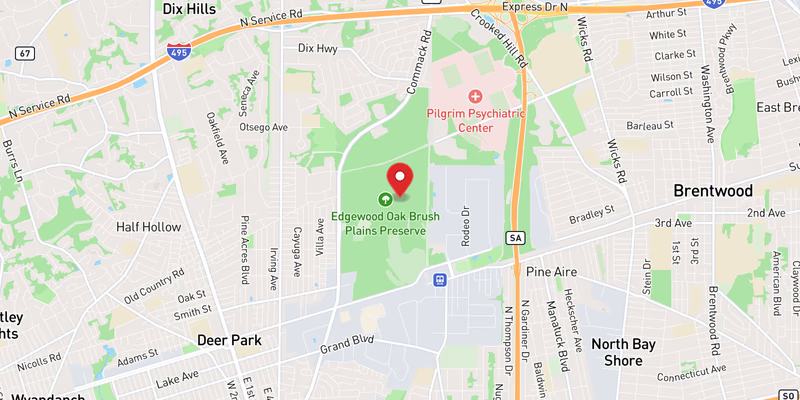
 Incident location, Long Island
What Happened
A driver on Long Island was arrested on a DWI charge on Saturday, June 20, 2026, according to an incident record classified as major severity. Beyond those foundational facts, details remain extremely limited at this time. No official police press release had been published as of this report’s initial publication, and the specific road, town, direction of travel, and time of the arrest or associated crash have not yet been confirmed by any law enforcement agency.
The name, age, and hometown of the person arrested have not yet been released by authorities. Police have not yet confirmed whether additional vehicles were involved, whether any other parties sustained injuries, or what specific circumstances — a traffic stop, a crash, or a civilian report — led to the DWI arrest. Long Island Traffic will update this article as those details become available from official sources.
It is also not yet known which agency made the arrest. Long Island DWI enforcement falls under the jurisdiction of multiple agencies depending on the road type and town: the Nassau County Police Department, the Suffolk County Police Department, and the New York State Police all actively patrol Long Island roadways and handle impaired-driving enforcement. The responding agency, along with any assisting units, has not been identified in the incident record.
The severity classification of “major” suggests this incident may involve injury, significant property damage, or a crash rather than a routine traffic stop alone — but police have not yet confirmed the circumstances. Long Island Traffic will monitor official releases from all relevant agencies.
Location & Road Context
No specific road or municipality has been confirmed for this incident. Long Island’s road network spans two counties — Nassau and Suffolk — and includes a mix of high-speed parkways, state highways, and local roads that see significant nighttime and weekend traffic volume, particularly on weekend evenings when DWI enforcement activity is typically elevated. Once a specific location is identified, Long Island Traffic will add road-level context, including crash history and traffic data, through our roads directory.
Readers traveling Long Island roadways this weekend can monitor real-time conditions through 511NY, the state’s official traffic information platform, which tracks active incidents and closures.
What This DWI Charge Means
Under New York Vehicle and Traffic Law §1192, impaired-driving offenses are broken into several tiers based on blood-alcohol content and other factors. A DWAI (Driving While Ability Impaired) charge applies when a driver’s BAC is between 0.05 and 0.07, or when impairment is otherwise demonstrated; it is a traffic infraction, not a criminal charge, and carries fines up to $500, a 90-day license suspension, and possible jail of up to 15 days for a first offense. A standard DWI charge (VTL §1192.2 or §1192.3) applies at a BAC of 0.08 or above, or when a driver is intoxicated by any substance; as a misdemeanor for a first offense, it carries fines of $500–$1,000, a minimum six-month license revocation, and up to one year in jail. Aggravated DWI (VTL §1192.2-a) applies at a BAC of 0.18 or higher and carries steeper fines of $1,000–$2,500 and a mandatory one-year revocation, even on a first offense.
For any conviction at the DWI level or above, New York State requires the installation of an ignition interlock device on all vehicles the convicted person owns or operates, typically for a minimum of 12 months. Repeat offenders — those with a prior DWI conviction within the past 10 years — face felony charges, enhanced fines, longer revocations, and mandatory minimum jail terms. The specific charge level in this case has not yet been released by authorities.
Drivers who refuse a chemical test (breathalyzer or blood test) face automatic consequences under New York’s Implied Consent Law: a one-year license revocation and a $500 civil penalty for a first refusal, even if no DWI conviction follows. A second refusal within five years results in an 18-month revocation and an $750 penalty. Refusal can also be used as evidence against a driver in criminal proceedings.
Case Status & Updates
It is important to note that an arrest or charge is an accusation, not a conviction. The individual involved in this incident is presumed innocent unless and until proven guilty in a court of law. This is a foundational principle of the American legal system, and Long Island Traffic does not characterize any charged person as guilty prior to a court finding.
Once the arrested driver is formally charged, the case is expected to be arraigned at the local New York district court — either Nassau County District Court or the appropriate Suffolk County district court — before proceeding through the Long Island criminal court system. DWI cases typically involve arraignment, a plea, and either a negotiated disposition or trial.
Long Island Traffic tracks DWI cases through the courts. We update each report with arraignment outcomes, pleas, and sentencing results as they become part of the public record. Bookmark this page or check our accidents tracker for future updates on this case as official information is released.