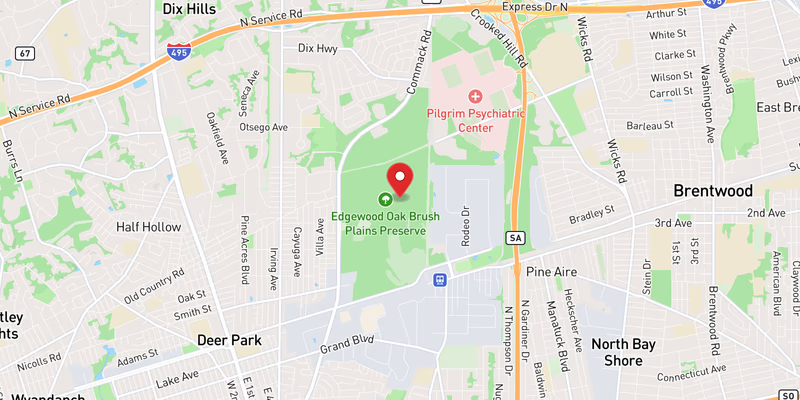
 Incident location, Long Island
What Happened
A driver was arrested on a charge of Driving While Intoxicated (DWI) on Long Island on Thursday, June 25, 2026, according to an incident record classified as major in severity. Beyond those foundational facts, details remain limited at this stage of the investigation.
Authorities have not yet publicly identified the driver by name, age, or hometown. The specific road, town, and time of the arrest have likewise not been confirmed in any official release reviewed by Long Island Traffic. It is not yet known whether the arrest followed a collision, a traffic stop, or a sobriety checkpoint encounter — police have not yet confirmed the circumstances that led to the DWI charge.
Whether any other vehicles, pedestrians, or cyclists were involved is also unconfirmed. The “major” severity classification may reflect injuries to one or more parties, significant property damage, or the circumstances of the impairment itself, but police have not yet released clarifying information. Long Island Traffic is monitoring official channels — including agency press releases and court records — and will update this report as verified facts become available.
No official quotes from law enforcement or witnesses have been released at this time. This report is based solely on the structured incident record; no external news coverage of this specific event was available at the time of publication.
Location & Road Context
The precise location of this incident — including the road name, direction of travel, town, and any nearby intersections or landmarks — has not yet been disclosed by officials. Long Island’s road network spans two counties, Nassau and Suffolk, and encompasses everything from high-speed divided expressways like the Long Island Expressway and Southern State Parkway to local county roads and village streets, each presenting distinct DWI enforcement and collision risk profiles.
Once the exact location is confirmed, Long Island Traffic will provide full road context, including traffic volume data, crash history at that corridor, and any relevant infrastructure details. Readers can also track Long Island DWI incidents through our ongoing coverage archive.
Investigation & Legal Proceedings
An arrest on a DWI charge represents the beginning of a legal process, not its conclusion. Once formally charged, the accused is expected to be arraigned at the local New York district court serving the town or village where the arrest occurred — either in Nassau or Suffolk County — and the case would then proceed through Long Island’s criminal court system.
No bail information, arraignment date, or prosecutorial statements have been released. The investigation is considered ongoing, and the specific charge tier — which determines penalties, license consequences, and mandatory program enrollment — has not yet been confirmed publicly.
What This DWI Charge Means
Under New York Vehicle and Traffic Law §1192, impaired and intoxicated driving is prosecuted under three primary tiers. A DWAI (Driving While Ability Impaired), which applies at a BAC of 0.05–0.07, is a traffic infraction — not a crime — but still carries fines up to $500, a 90-day license suspension, and up to 15 days in jail for a first offense. A standard DWI, triggered at a BAC of 0.08 or higher, is a misdemeanor on a first offense, carrying fines of $500–$1,000, a minimum six-month license revocation, and up to one year in jail. Aggravated DWI, applied when BAC reaches 0.18 or above, escalates those penalties to fines of $1,000–$2,500 and up to one year in jail on a first offense — and can be charged as a felony if a prior conviction exists within ten years.
All DWI and Aggravated DWI convictions in New York require the installation of a mandatory ignition interlock device on any vehicle the convicted person owns or operates. Repeat offenders face felony charges under VTL §1192, with significantly longer license revocations, larger fines, and potential multi-year prison sentences. If a fatality or serious physical injury resulted from this incident — which remains unconfirmed — the charge could escalate to Vehicular Manslaughter or Assault, both of which carry felony exposure under New York Penal Law.
Drivers who refuse a chemical test (breathalyzer or blood draw) in New York face automatic consequences under the state’s implied consent law: a one-year license revocation and a $500 civil penalty for a first refusal, independent of any criminal outcome. A refusal can also be used as evidence of consciousness of guilt in court proceedings. Whether a chemical test was administered or refused in this case has not yet been confirmed by police.
Case Status & Updates
It is important to emphasize that an arrest or charge is an accusation, not a conviction. The individual involved in this incident is presumed innocent until proven guilty in a court of law. Long Island Traffic does not editorialize about guilt or culpability prior to adjudication.
Long Island Traffic tracks DWI cases through the full arc of Long Island’s court system and updates each report when arraignment outcomes, plea agreements, trial verdicts, or sentencing decisions become part of the public record. Readers who have direct knowledge of this incident — including the location, the parties involved, or the circumstances — are encouraged to contact us so we can seek official confirmation. Check back at longislandtraffic.com/accidents/dwi/ for updates to this case as they are confirmed.
Broader Impact
DWI enforcement on Long Island remains a year-round priority for both the Nassau County Police Department and the Suffolk County Police Department, with both departments conducting regular sobriety checkpoints and saturation patrols, particularly during summer months when traffic volume and social activity increase. The classification of this incident as “major” underscores the serious potential consequences of impaired driving on Long Island’s roadways.