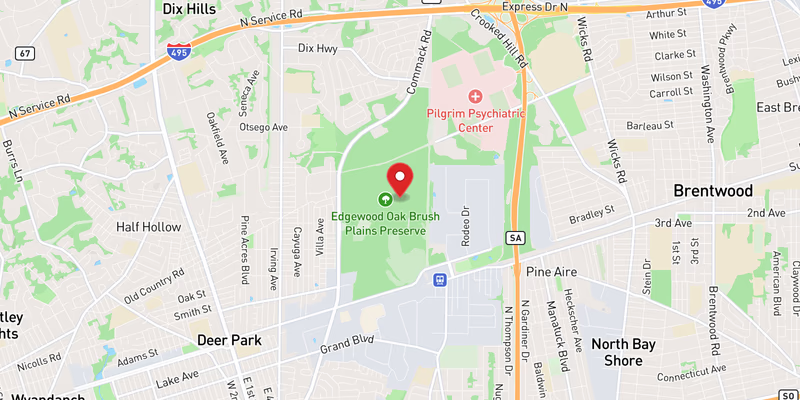
 Incident location, Long Island
What Happened
A driver was arrested on a DWI charge on Long Island on Saturday, June 27, 2026, according to available incident records. The event has been classified as major in severity, suggesting serious consequences — potentially injuries, a significant collision, or both — though police have not yet released confirming details.
Beyond the date, general location, and charge classification, details remain limited. No official agency press release had been issued at the time of publication confirming the specific road, town, cross-street, or mile marker where the arrest took place. The name, age, and hometown of the driver taken into custody have not been publicly confirmed. It is also not yet known whether any other vehicles or pedestrians were involved, what time the arrest occurred, or what specific circumstances led officers to make the stop or respond to the scene.
No responding agencies have been named in available records, meaning it is unclear whether this incident falls under the jurisdiction of the Nassau County Police Department, the Suffolk County Police Department, or the New York State Police — all of which regularly handle DWI enforcement across Long Island’s roads and highways.
Long Island Traffic is actively monitoring this case. This report will be updated as police release further information, including the identity of the accused, the precise location, the nature of any injuries, and the charges filed.
Location & Road Context
No specific road or town has been confirmed for this incident. Long Island’s road network spans two counties — Nassau and Suffolk — and includes major corridors such as the Long Island Expressway (I-495), the Northern State Parkway, the Southern State Parkway, and dozens of state and county routes where DWI stops and crashes are regularly recorded. Until authorities confirm the location, no road-specific statistics can be applied to this report.
For real-time road conditions across Long Island, readers can check 511NY, the official statewide traffic information service.
What This DWI Charge Means
Under New York Vehicle and Traffic Law §1192, there are several levels of impaired-driving offenses, and the consequences escalate significantly with BAC and prior record. A DWAI (Driving While Ability Impaired) charge applies when a driver’s BAC is between 0.05 and 0.07, and is treated as a traffic infraction rather than a crime for a first offense — carrying fines between $300 and $500, up to 15 days in jail, and a 90-day license suspension. A standard DWI charge kicks in at a BAC of 0.08 or higher, constituting a misdemeanor on a first offense, with fines of $500–$1,000, up to one year in jail, and a minimum six-month license revocation. Aggravated DWI — for a BAC of 0.18 or higher — carries steeper fines of $1,000–$2,500, up to one year in jail on a first offense, and a minimum one-year license revocation.
For repeat offenders, the stakes are considerably higher. A second DWI conviction within ten years is a Class E felony, bringing fines of $1,000–$5,000 and up to four years in prison. New York also mandates an ignition interlock device for all DWI convictions — not just repeat offenses — requiring the convicted driver to blow into a breathalyzer before the vehicle will start. The specific charge level applicable in this June 27 arrest has not yet been confirmed by police.
Drivers should also be aware of New York’s implied consent law: refusing a chemical test (breathalyzer or blood draw) at the time of arrest results in an automatic one-year license revocation and a $500 civil penalty — consequences that are imposed by the DMV entirely separately from any criminal court proceedings. A refusal can also be used against a defendant as evidence in court. More information on your rights during a DWI stop is available on our Know Your Rights page.
Case Status & Updates
It is important to note that an arrest or charge is an accusation only. The individual taken into custody on June 27, 2026 is presumed innocent until proven guilty in a court of law. No conviction has been entered, and police have not yet publicly confirmed the full details of this case.
Once formally charged, the case is expected to be arraigned at the appropriate local New York district court — either in Nassau or Suffolk County depending on where the arrest occurred — and will proceed through Long Island’s criminal court system. At arraignment, a judge will formally read the charges, set bail or release conditions, and schedule future court dates.
Long Island Traffic tracks DWI cases through the courts and updates each report with arraignment outcomes, guilty pleas, trial results, and sentencing as they become part of the public record. Bookmark this page or check our accidents section for the latest developments in this case.