What Happened
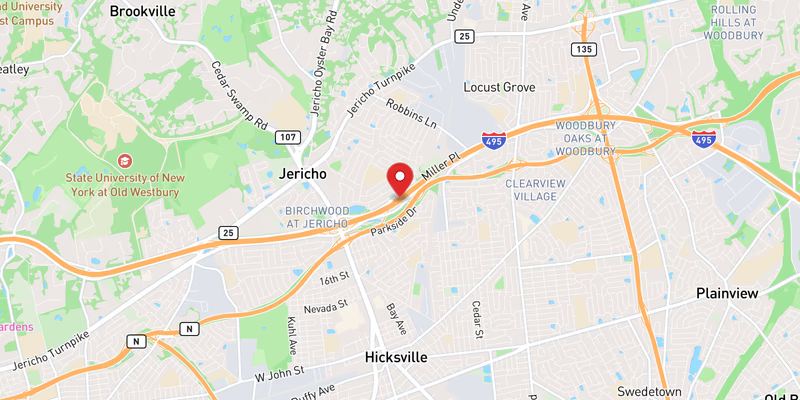
A bus became disabled on the eastbound Long Island Expressway (I-495) in Nassau County on Friday, June 12, 2026, blocking the right shoulder of the highway, according to incident data logged in the Long Island Traffic database. The incident is classified as minor in severity, and details remain limited as of the time of this report.
The right shoulder of eastbound I-495 was reported as blocked as a result of the breakdown. No injuries have been officially confirmed by authorities, and police have not yet released any additional information regarding the number of passengers on board, the specific bus operator or transit agency involved, or the precise mile marker or exit where the vehicle came to a stop. It is not yet confirmed whether the bus was a public transit vehicle — such as an MTA or Nassau Inter-County Express (NICE) bus — or a private charter or school bus.
The exact time of the breakdown has not been confirmed in the available official record. Motorists traveling eastbound through Nassau County on the LIE during the Friday commute were advised to exercise caution in the area, as a stopped large vehicle on the shoulder can significantly narrow the effective travel lane width and reduce sight lines for approaching drivers.
Friday, June 12, 2026 brought a notably high volume of incidents to the I-495 corridor. In addition to this disabled bus report, Long Island Traffic’s records for that date include a separate, major-severity disabled bus on I-495, at least two additional crashes on I-495, ongoing construction activity along the expressway, tree-trimming roadwork on the Long Island Expressway HOV Lane, and signal repair work on the I-495 service road (SSR). The concentration of incidents and work zones across multiple points of the LIE on the same day created compounding challenges for Nassau County commuters. Further details on responding agencies — such as whether NCPD highway patrol, a towing contractor, or MTA operations staff responded — have not yet been confirmed in the official record.
Location & Road Context
The Long Island Expressway (I-495) is one of the most heavily traveled and most incident-prone corridors on Long Island. Long Island Traffic’s I-495 road page shows 1,069 recorded incidents on this highway in our database, making it one of the highest-volume roads tracked in our system. The expressway serves as the primary east-west spine of Long Island, carrying hundreds of thousands of vehicles daily between Queens and Riverhead, and the Nassau County stretch in particular sees dense commuter and commercial truck traffic during morning and evening peak hours.
Nassau County itself has 533 recorded accidents in the Long Island Traffic local incident database. The eastbound direction of I-495 through Nassau County is a frequent site of shoulder blockages, disabled vehicles, and rear-end collisions — particularly during the afternoon and evening rush, when stop-and-go traffic increases the risk of drivers failing to notice slowed or stopped vehicles ahead. A large vehicle stopped on the right shoulder, such as a bus, can be especially hazardous when the breakdown occurs near a curve, an on-ramp merge zone, or a stretch where the shoulder narrows.
Broader Impact
Friday’s disabled bus is far from an isolated event on this stretch of highway. Just hours apart on the same date, a separate major-severity disabled bus incident was recorded on I-495, listed in the Long Island Traffic accidents database as a distinct entry. Also on June 12, a crash on I-495 was logged as a minor incident, and a Hempstead man was sentenced for a May 2025 wrong-way crash on the LIE in Roslyn, a moderate-severity case that highlights the deadly potential of the same roadway when driver behavior or vehicle failures create unexpected hazards. The clustering of incidents along I-495 on a single Friday underscores the expressway’s persistent vulnerability to cascading traffic disruptions — especially when large vehicles like buses are involved, as they require additional clearance for emergency response and towing operations that can extend shoulder blockages well beyond the initial breakdown window.